

One of the most commonly asked questions I get about my experience teaching overseas is; “if you could do it all over again Caz, would you?”
It’s a hard question to answer, as my teaching days offered me the chance to explore the world, make new friends, and total cultural immersion.
It also presented some challenges, some that I hadn’t anticipated until I got out there and started teaching.
So I decided to write this guide on my experience teaching overseas, to help anyone thinking about teaching English as a foreign language abroad, or teaching anything really.
This is based on my personal experience, and some of these opinions and stories may not apply to everyone, but I hope it gives you an honest view of what this experience is like.
My Experience Teaching Overseas
London (1997-1999)

Talk about being thrown in the deep end.
I had my interview with a teaching agency in the UK before I finished Uni. I was accepted and so when I arrived in London in 1997 on my UK working holiday visa, I was ready to start my teaching career in Hackney, East London – an area I was soon to discover to be one of London’s most challenging areas.
I wasn’t quite ready to settle into a full-time job as I had travel on my horizon, so I went straight for the supply (casual, substitute) teaching.
This meant I was running all over the East End going to different schools every day. It was a great way for me to get to know the city… and lose a whole lot of weight.
It was also a fantastic way for me to learn how to be an adaptable teacher – different students, different classes, different experiences, every day.
There is nothing like stopping students from throwing chairs at each other; teaching a whole class of Bangladeshi students with limited English; and having a 7 year old boy you just met scream at you “You f**king b***h” before compassion hits you as you realize he was the boy whose mother you saw getting arrested in the school foyer that morning; and learning how to manage a Somalian refugee with severe autism.
Yep. That is real learning right there.
In the midst of this, I did have a couple of permanent days at some schools throughout my one and half years of supply teaching.
For the last six months, I decided to find a more permanent position, and had a Year 5 class at a pretty good school.
A highlight of that was the Class Space play we created and performed for the whole school. A little nerve wracking, but lots of fun.
- Top benefits: get to experience a lot and learn a lot of skills, less pressure on you as a supply teacher (there’s an expectation of supply teachers to just keep kids busy), meet lots of diverse cultures.
- Biggest challenges: No continuous class (it helps to have the same students so you can build a rapport), high-stress, never knowing where you’re going.
- Salaries: salaries can vary depending on your experience and where you are teaching. I was earning £100 per day back in the 90s, but today you can expect to earn £31,000 to over £41,000 per year in London.
- Qualifications required: A Bachelor’s Degree in Education or Postgraduate Certificate in Education, which must come with QTS (qualified teacher status). This is essentially a practicum section of your course, so if you can prove this, you can apply for QTS. Excellent English language skills (though not necessarily native speaker), subject knowledge if not teaching English.
- Other requirements: work visa, criminal background check (known as a DBS check in the UK), prior teaching experience is desirable but not essential.
Sydney (2000-2002)
After my very educational London teaching experience, I returned home and managed to secure a position teaching Year 4 at a very nice school in Wahroonga on Sydney’s North Shore.
The principal hired me because she had spent a couple of years in her youth traveling and knew just how much it made you grow as a person and what it could teach you about life.
She took a chance on me where other principals weren’t so willing. In their eyes my jet-set lifestyle wasn’t as professionally appealing.
Wahroonga is a very wealthy suburb, and I found myself teaching the children of some pretty influential people, like the head of Australia Sony Music and AMP, our biggest insurance provider.
I also had a student in my class who performed in Les Miserables for the Aussie Broadway version, and a member of the Qantas choir.
After the challenges of London, this was a total dream teaching experience for me.
- Top benefits: great class and lots of fun, a laid-back location and a good school who cares about their teachers.
- Biggest challenges: the usual challenges in public schools – behavioural issues, lots of marking to do etc
- Salaries: salaries can vary depending on your experience. An entry level teacher can earn from $70,000–$80,000 AUS a year, and more experienced teachers can earn $90,000–$100,000+ AUS.
- Qualifications required: A Bachelor’s Degree and some formal teaching qualification such as a Graduate Diploma in Education, complete the Australian Institute for Teaching and School Leadership (AITSL) test, be registered with the state’s teacher accreditation board.
- Other requirements: work visa, criminal background check, and pass a Working with Children Check.
If you’re doing a working holiday, you may like Global Work and Travel to help you find a job.
Bangkok (2002)
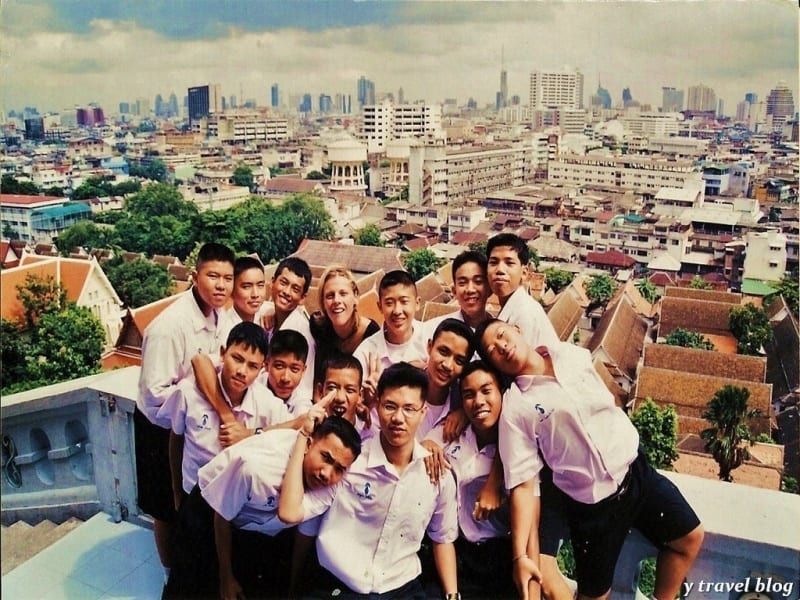
Foreign teacher with blond hair and blue eyes walks up on stage, grabs the microphone to address 500 high school boys in a language barely any of them could understand.
Yet they nodded to me like they understood everything and welcomed me with ginormous smiles.
Welcome to teaching in Bangkok. This is the teaching English abroad job of dreams! That said, there were some challenges…
For six months, I taught every class from Year 7 to Year 12, each having numbers that ranged from 15 – 42 students.
I had some boys who could barely say hello and some that I could hold conversations with, making it almost impossible to teach.
I had to learn how to aim for the middle and do my best to differentiate with the non-existent resources I had.
I became very good at getting my message across using non-verbal forms of communications. The boys loved my ridiculous mimes, charades, and games.
As my school was attached to one of the oldest and most respected temples in Thailand, Wat Saket, I was able to attend many important ceremonies during my time there.

I also helped to organize a two-day English camp at a beach not far from Bangkok. Many of these students had never seen the ocean before and it was one of my teaching highlights to be able to gift them that opportunity and have a really fun time together.
My students in Bangkok taught me far more than I taught them.
I also taught at a private language school part-time for six hours on a Saturday. For this one day, I received half my monthly wage at my high school. The school was connected to Chulalongkorn University and had amazing resources and small ability-based classes.
Lodging in an old converted office on the third floor was also given as a benefit.
- Top benefits: great classes with polite, well mannered students, free housing, cultural immersion, and Bangkok is a great base to explore other destinations in Asia.
- Biggest challenges: large discrepancy with abilities in each class, not a lot of learning aids or resources, pay is lower than the UK and Australia, but you don’t need as much money to get by in Bangkok as there is a low cost of living.
- Salaries: I was earning $500 USD per month at Wat Saket back in 2002, but today English teachers are paid usually around $700-$900 per month in language centers, government or public schools, and a little more in private schools. Go-Inter Language School paid me $250 for 6 hours teaching. Before you bulk at the price, remember that a plate of Pad Thai in Bangkok is $2.
- Qualifications required: A Bachelor’s Degree in any subject, and a TESOL Certificate, or TEFL Certification that’s at least 120 hours.
- Other requirements: work visa (Non-Immigrant B Visa), a clean criminal record, a health certificate, be over 21 years old.
Dublin (2003)

My experience teaching in Dublin was one of my favourite teaching experiences to date.
I was not allowed to teach a class of my own as all teachers have to be able to speak Gaelic in order to teach. So I started off supply teaching as this was allowed.
I found a job advertised in the paper for a Language Resource Teacher, and applied.
The Principal of the school, phoned and suggested I meet him for an interview at the school’s Christmas party at the pub. I responded with delight and over red wine, we discussed all things Aussie Rules and Gaelic football, to which he was a major fan.
School was not talked about only to say, “You’re hired!”
For six months, my job alternated between teaching small groups of newly arrived immigrants English, and the Irish minority people.
If you have seen the movie ‘Snatch’ then you know what I am talking about. It was a real eye-opening cultural experience for me.
The job was brilliant, and I just loved the people I worked with. It was too easy; the only way the Irish know how to do things.
Apart from the teaching, I also took them on tours around Dublin to famous landmarks and historical places. Free tours for myself!
While in Dublin, I did a 100 hour TEFL course, which gave me the opportunity to teach English to Italian high school students during the summer at a language school. Back then, TEFL-certified teachers weren’t required to teach abroad, but today most schools require one.
I had a teaching degree from Australia, which was enough for most English teaching jobs, but some time in the early 2000s more people were applying to become ESL teachers and prompted more places to require a formal education in teaching English as a second language – you need more than just being a native English speaker.
Pay – 140 euros a day.
- Top benefits: total cultural immersion, living in Dublin was a blast and the local community is so welcoming and hospitable, I got some free tours out of it, I learned a lot.
- Biggest challenges: a lot of students had no foundation of English, I could only sub teach, which meant no class of my own.
- Salaries: At the time, I was earning €140 Euros a day. Today, foreign teachers can expect to earn about €20 per hour if they are teaching English as a second language. To teach in a school, the salary is €30,000–€46,000 per year, but as I mentioned earlier, you need to be able to speak Gaelic.
- Qualifications required: A degree in teaching that’s recognized by the Teaching Council of Ireland, such as a Bachelor of Education or Master of Education, be able to speak Gaelic as per the Teaching Council’s IEE requirements, have a high subject knowledge.
- Other requirements: work visa (Non-Immigrant B Visa), a high level of English, a clean criminal record, be vetted by the National Vetting Bureau, and register with the Teaching Council.
USA (2004-2006, 2008-2010)
Teaching in the US was a fantastic cultural experience for me as well as really helping me to grow in strength as a teacher. Not only that, but it gave Craig and I a way to live in the States like we had always wanted. We loved it.

I taught Grade 5 for my four years there at two different schools. And my last year, I had half the day re-mediating small groups of students, which I loved, and the other half teaching Year 5 Science and Social Studies.
VIF was the cultural exchange teaching program who hired and placed me.
It was founded by two brothers from Chapel Hill who had spent years studying overseas and traveling.
They understood the need and benefits to American children being exposed to those from other countries, and so built a large organization who recruits teachers from around the world.
I have gone through their program twice now and loved it. It gave me the opportunity to meet fellow international teachers, and a support system to assimilate into teaching in the US, which was incredibly different to what I had previously been used to.
I miss my US school family and the feeling that I was doing something important. Not only helping students to have an education, but bringing the world to many who would never get a chance to travel
Ever year, I did an Australian exhibition where the students would display information they learned about a certain aspect of Australia and its culture, as well as having food to try, games to play and other interactive exhibits. It was fun and the students gained so much from it.
My final year I ran a five minute morning broadcast show on Australia, which was a ton of fun. I loved being wacky singing Australian songs, making animal noises and other crazy things.
- Top benefits: return flights to the US, subsidized health insurance, reduced car insurance, interest free relocation loan, sign on bonus from school district approx $38,000 USD a year.
- Biggest challenges: getting a visa and going through the admin is a pain for foreign teachers, going through an agency really helps with this. The job is quite demanding.
- Salaries: Depending on your experience, you could earn $46,590 – $63,500 per year.
- Qualifications required: A degree in teaching, such as a Bachelor or Master of Education, proof of your teaching license or certification in your country, have a high subject knowledge.
- Other requirements: work visa (Non-Immigrant B Visa), a high level of English fluency (TOEFL or IELTS scores if non native speaker), a letter of recommendation, a clean criminal record and background check (usually with finger printing)
Would I Recommend Teaching Overseas?
So, would I recommend teaching overseas? I have to pause for a moment to think about my answer; an answer that would either show a life filled with regret or one with gratitude for the experiences I had been served.
Honestly, there are plenty of career paths I wish I did choose instead. Things that I were more passionate about and perhaps more highly skilled in.
I enrolled into teaching because I didn’t know what else to do, nor did I know what I was good at. I had no sense of myself and what I was hoping to achieve with my life. I just chose something for the sake of choosing it.
Everything in life happens for a reason, and sometimes when your path is not clear to you, it is clear to some other unseen force who guides you until you get it.
And you know what – teaching lead me to find that out.
Sure it has its ups and downs, but through those challenges you find yourself, and those ups stay with you for a lifetime. So yes, I would recommend teaching overseas – there’s no doubt it is a life changing adventure in your life. And we’re all about saying “yes” to adventure.
My own teaching adventure, and travelling the world for many years, I’ve learned it really is possible to combine both when you make it a working holiday experience.
Doing this as a teacher gives you the added bonus of good pay, benefits, frequent holidays, cultural insights, and incredible experiences that can only make you a better teacher.
